Hal-hal apa saja yang membuat memilih genre Reggae ?
Sebenarnya berdasarkan pengalaman batin aja sich, banyak alasan yang mebuat memilih genre reggae.
Sejak kapan mulai konsen di genre reggae?
Belum lama sich sekitar 1989
Apakah harus Dreadlock bagi pecinta maupun praktisi musik reggae?
Pencinta musik reggae tidak harus gimbal, sebenarnya juga kembali pada filosofi itu sendiri bagaimana pendengar dan perilaku dalam menyikapi lirik atau musik reggae itu seperti apa.
Inspirasi lagu dari mana (influencenya)?
Tentu saja Bob Marley, dia seorang yang fenomenal secara musical, penulisan liriknya bagus.
Sudah berapa album? Bisa sebutkan?
- 1996 Rambut Gimbal
- 1997 Gue Falling In Love
- 2000 Damai dengan cinta
- 2003 Kronologi
- 2005 Salam damai
Selain bermusik ada hobi lain?
Ada, sebenarnya banyak sih...tapi saya suka melukis...
Harapan Mas terhadap perkembagan musik reggae di Indonesia?
Ditekankan pada para pelaku musik reggae, bagaimana esensi musik reggae di perjuangkan bukan sekedar gimbal atau ganja. Dan yang paling penting esensi perdamaian, kemerdekaan arti sebuah musik, dan lebih pada edukasi agar tidak menjadi salah mengartikan musik reggae itu sendiri.
Pengalaman yang paling berkesan selama bermusik ?
Salah satu lagu saya yaitu Pat Gulipat masuk dalam kompilasi World Reggae berjudul Reggae Playground bersama musisi reggae dunia yang diproduksi oleh Putu Mayo World Record.
Salam Damai..
Management :
Jl.Puloasem I C no. 57 Rawamangun, Jakarta Timur
Phone: (021) 4895326 - Fax :(021) 4757005
Ibnu ( Manager) at 08129217757Nino (Album Management)
E-mail : indonesia_rasta@yahoo.com
:: Tony Q Rastafara ::
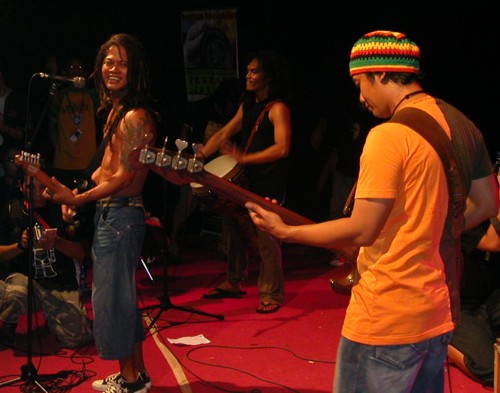
Reggae Culture Salute celebrates 40 years of the Mighty Diamonds
The Mighty Diamonds, the only Jamaican group to boast the same members after forty years, will be honoured at Reggae Culture Salute 2009, scheduled for the Performance Centre at Nazareth Regional High School in Brooklyn, New York on Sunday, November 1.
The Coalition to Preserve Reggae Music will use the platform to have a twin celebration - the 40th anniversary of the Mighty Diamonds and the 79th anniversary of the coronation of His Imperial Majesty Emperor Haile Selassie I and Empress Mennen of Ethiopia.
Performances will come from Warrior King, Everton Blender, the Mighty Diamonds, the Ethiopian World Federation Nyahbinghi Drummers along with Dub Poet Infinity and roots singer, Ossie Dellimore.
The Mighty Diamonds ranks high among the pioneers in the pantheon of reggae music. Their name is synonymous with Rastafari and Roots Reggae and the trio has been entertaining and educating the world for years with their sweet harmonies, conscious lyrics and polished performances.
The annual Reggae Cultural Salute is a multimedia presentation which highlights the unique relationship between Reggae, Rasta, Selassie, and Jamaica and is also a benefit concert for the Coalition to Preserve Reggae Music (CPR) Community Conversation Series.
Reggae Culture Salute is a family-friendly, first-class showcase of the best of Roots Reggae suited for reggae aficionados as well as newcomers.
The New York Times called the 2006 staging of Reggae Culture Salute "a celebration of reggae's old -fashioned family values". The fifth annual Reggae Culture Salute will continue the tradition of presenting diverse stages of the genre's evolution.
The event also features a full screening of Stephanie Black's film, Africa Unite, about the 2005 Marley family concert held in Ethiopia in honour of Bob's 60th birthday. It was premiered at Reggae Culture Salute 2007.

Julian Marley spreading message of 'oneness and unity'
It's obvious that Julian Marley has been in town. He has been doing all the right "pee-arrey" stuff - morning television, lots of radio and some print in which he has been enthusiastically talking about his latest CD, Arise and his upcoming US tour of the same name with his 7Uprising band.
MARLEY... Marley sees his music, above all else, as the medium through which he spreads his message of 'oneness and unity to the world'
The tour was scheduled to kick off last night in Jacksonville, Florida, and Julian told Splash last Friday that he has been doing rigorous preparation for the six-week journey. "It has been four weeks of solid rehearsals everyday, getting the voice and everything up to date," he said.
Having accomplished that, he says he is ready for the real challenge of the road. He so far has 34 US dates confirmed and will see him moving through cities including New Orleans, Austin, Albuquerque, Pozo, Los Angeles, Santa Cruz, Eureka, Durango, Aspen, Boulder, Minneapolis, CHarlote and Atlanta.
Marley sees his music, above all else, as the medium through which he spreads his message of "oneness and unity to the world".
"Me is a man play music from me lickle," he explains. "Me think 'bout music 24/7 . it always in me brain," Julian shared.
And although the six-year gap between Arise and his last been six CD (A Time And Place, 03) leads one to ask pertinent questions, Julian is still all smiles. "The six-year gap," he pondered. "Well it was a period of growth and maturity," he reflects.
"Ah not saying I did like it . but give thanks for those six years. But no more six years like that," he assures.
Arise, he says is a fusion of roots reggae with more modern beats. "The title is what it is. Every song give you that upfull vibe," is Julian's take on the CD, on which his band, Uprising, is heavily featured.
The aggregation has been with Marley since 1991 and the synergy is unmatched. "The band started with the bass players Owen 'JB' Reid and then we bring in other people and get the thing just right. Uprising played on almost all the tracks for the CD, so they know it," he said, pleased.
Not surprisingly, Arise is one of 39 albums submitted for what is called 'consideration' to the board of the National Academy of Recording Arts and Sciences for the Reggae category. Those album which given the most favourable consideration will be shortlisted and placed in the official Reggae Grammy category.
However, while Julian is quite thankful at being considered, he says his main focus is making good music. And should he be short-listed for the Grammy and subsequently join the ranks of his musical siblings and father, all of whom are in possession of the coveted gamophone statuette, Julian "woulda just give thanks for that too".

Reggae artist says NYC man slashed him with sword
NEW YORK
Jamaican reggae artist Major Mackerel was slashed Sunday on the head, arm and hand by a neighbor wielding a two-foot-long sword, the musician and police said.
Major Mackerel, who attracted some recognition in the 1980s and 1990s as a dancehall reggae artist, was seen hours after the attack returning to his Brooklyn home. He had white bandages crowning his dreadlocks and wrapped around one hand, a wrist and elbow.
"I had a fight and I got cut," Major Mackerel told the Daily News.
The reggae artist, whose real name is Garfield Dixon, said he got into a fight earlier in the day with a neighbor, identified by police as Oscar Joseph, outside a two-story brick house on East 91st Street where they live on separate floors.
World Reggae "Various Artists"
::World Reggae ::
"If music is the universal language, then reggae is its most widely spoken dialect." As the liner notes to this latest Putumayo release assert, reggae has unprecedented global commercial appeal. It is fascinating that the music of a marginalized group from a tiny island in the Caribbean has entered the mainstream enough to warrant a reliable slot on any index of genres. That easy to feel, up-beat groove has been manipulated to varying aesthetic results and for various political agendas. World Reggae, along the same lines as an earlier Putumayo release entitled Reggae Around the World, certainly illustrates these varying aesthetic results.
The CD gets off to a slow start with "Pas de Problèmes," by the French band Kana. The listener is urged to "just be yourself." I would not say that anything about this track resembles the Toots and the Maytals, as the liner notes profess, however the groove is pleasant enough. It was the whiney singing and accompanying cheese that thwarted this reviewer's attempt to just be himself. Digging the hole deeper is Apache Indian with "Om Numah Shivaya." Sung in fake patois, "the lyrics are inspired by Apache Indian's personal quest to define his identity in a multicultural world where traditional definitions of religion and culture have to be reevaluated." Good luck with that one, Apache.
Majek Fashek steps in to save the day with something almost skank-worthy. The talking drum's presence in "African Unity" counters the specter of those ubiquitous synthesizer lines that so often taint otherwise enjoyable compositions. Maria de Barros follows with "Riberonzinha," a Cape Verdean reggae excursion done with the smoothness often cited as characteristic of the island's music. Alpha Blondy, a reliable exponent of "world reggae," gets a deserved slot to do his thing. A track from Chis Combette of French Guyana is an interesting addition. Combette's "Babylone Buildings" features the sitar, played by Mungal Patasar (a Trinidadian), an amusing addition to the reggae ensemble given the history of East Indian indentured labor in the Caribbean. Combette's voice sounds a little like a Francophone Sting, assign your own connotations there.
The real standout of this compilation is the Algerian collective Gwana Diffusion. "Ya Laymi" finds a happy medium between the worlds of raï and reggae. The bass line is sufficiently phat and the singing executed with intention. One can hear conversation among the instruments and the Algerian flavor comes across without overstatement.
Of the countless reggae compilations out there, World Reggae is but a drop in the proverbial bucket. The strength of this particular release lies in its promotion of lesser known reggae fusions. There is no lack of interesting reggae outside of Jamaica, and maybe World Reggae will give some leads on where to find it. As for the general ideological thrust this collection, I suppose one could feel some warm and fuzzy sense of international empowerment by listening to this rather diluted, if well intentioned sampling of reggae's "world" manifestations. After all, it's "Guaranteed to make you feel good!" If you would like to board this "global musical journey from the Caribbean to Africa and beyond," go ahead, chirp down Babylon.

Isaac Haile Selassie
:: Los Angeles ::
In the annals of reggae music and its devotion to Emperor Haile Selassie, one thing becomes
striking by its absence: the lack of Ethiopian voices giving thanks and praise to the Almighty
God through the teachings of His Majesty. Now, from Addis Ababa, by way of Southern California, comes a striking new voice whose direct links to the King of Kings are stronger than any other singer and player of instruments this century has known.
If that seems hyperbole, consider the fact that Isaac Haile Selassie not only carries the
Imperial name, but was, in fact, raised under the supervision of His Majesty. "I have been blessed," recalls the singer from his cozy hillside cottage in Los Angeles, "to have been raised in the care of His Imperial Majesty personally, at his boarding school a few miles from
the palace. I used to see him at least once a week throughout my childhood."
When Selassie was deposed, Isaac recalls sadly, "I felt like I was cut into halves and I had no place in my own land. War and destruction surrounded me. So I decided to walk out of my country through the desert of Eritrea, all the way to the Sudan. My companions and I slept in the daytime and walked in the night, hiding like hyenas. I eventually found my way to Khartoum, Sudan, and one day I encountered a group of Ethiopians who were lying in the 120 degree heat under a fan in a small room, listening to Bob Marley on the radio."
This initial encounter with Jah music came as a visceral revelation. "His voice sounded like truth, although none of us could understand what he was saying. I'd never heard of dreadlocks or Jamaica or Rasta. I never knew there were these people abroad who loved Selassie I. But the spirit of this man just hit me like he hit the rest of the world."
Isaac eventually arrived in the United States in 1980 and by 1983 he had reached Los Angeles where he began performing publicly, starting in an Ethiopian restaurant, singing Ethiopian songs and reggae both in English and Amharic.
Isaac's message of unity, love and peace took off and he began playing at many of the local universities, popular clubs and venues like the African Marketplace, Beach Fest, Coconut Teaser, Kingston 12 and the Music Machine.
More recently, Isaac has performed at the Sierra Nevada World Music Festival (Marysville, CA) Roots Mountain Reggae (Tonasket, WA), Northwest Reggae Fest (Seattle, WA and Portland, OR), Roots Revolution Festival(Montana), Lake Casitas World Music Festival (Ojai, CA), One Root World Music Festival (Sacramento, CA) and was a headliner on the 2000 Annual Bob Marley Exodus Festival, traveling and performing throughout Texas and Arizona. He has played shows in Toronto, Canada, Boston and Cambridge, MA, Virginia, Boulder and Denver, CO and continues to tour and perform.
His debut CD, "UNITE" was chosen as one of the Top Ten reggae releases of 1999 and 2000. Ethiopia's history has been a struggle toward unity during the past millennium. I contribute this music for Ethiopians at home and abroad who starve for peace and unity and for Africans and the rest of the world who pray for happier times to come for all of us."

movie news
-
-
-
Lowongan Kerja Qatar Petroleum - Qatar Petroleum (UP) is the National Oil Company of the State of Qatar and Is situated in the capital city of Doha. Qatar is a country that has seen tremen...
 9 years ago
 -


